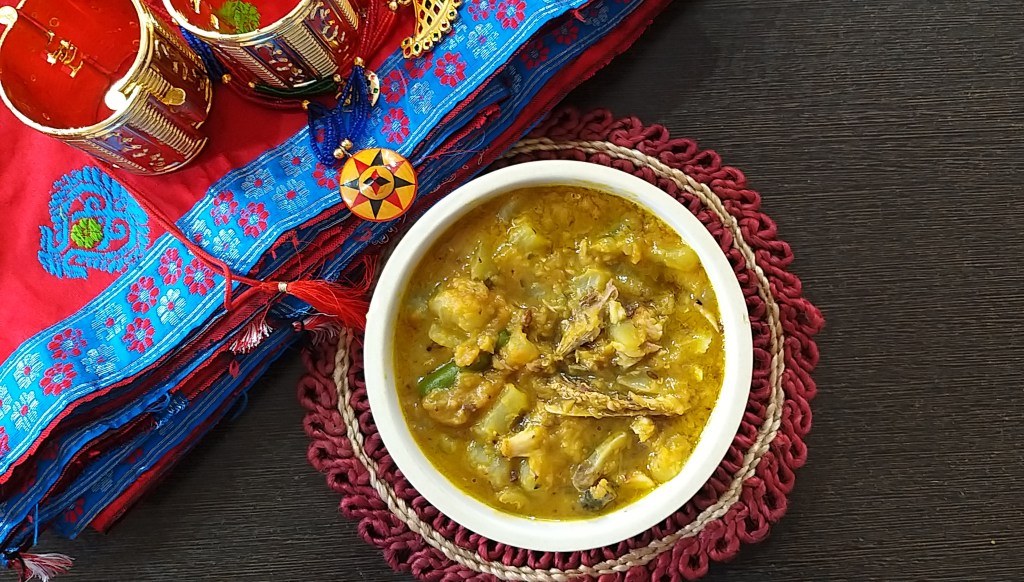
Assam is a land of various ethnic groups and culture, hence their food habits are diverse from something as simple as Guti Aloo Bhaji (Baby Potato Fry) to Muga Leta Fry (Silk Worm Fry). Khar is one such ingredient that is used in Assamese cuisine and it is unique to the Indian meals we usually know of. Khar is prepared by burning the skin of a banana called Bhimkol (a seeded variety of banana) and filtering out the ashes of the skin of the banana. Best thing about Khar is it can be preserved in glass containers and used for months. It is believed to be a palate cleanser and eaten in the beginning of a meal.
The history of Khar traces long back to the medieval ages. The supply of rock salt used to be coming from the Naga and Mishimi hill tribes of eastern territories who in turn collected it from the hills there. However frequent wars in the political fronts among royalty of Assamese and Naga territories almost regularly disturbed such supply leading to crisis of this commodity. Only influential people & aristocrats could afford to possess salt. The commoners had to be satisfied with home-made crude alkaline substances instead of salt.Thus derogatory use of the term Kharkhuwa can be attributed to these circumstances separating the commoners from the aristocrats of medieval Assam. A popular Assamese adage “lune… sune samaan” meaning Lun (Salt) and Sun (Gold) are equal also signified that salt used to be very costly and thus had to be substituted with Khar by majority people in the lower strata of economy.
As time changed, the kingdoms and royalty, the aristocracy disappeared; abundant supply of salt from other sources of various regions arrived and became easily available to all. However, use of Khar in the Assamese cuisine becomes permanent and so thus the use of the term Kharkhuwa still persists signifying a characteristic food habit of native Assamese people. (Source: Wikipedia)
For a cuisine that mostly uses acidic substances to elevate their dishes, Khar is a game changer rising from the ashes, literally. Khar is generally used with mushy, wet vegetables to go with and with fish heads to enhance its flavour to an optimum level. You can also use stir-fried vegetables from the leftovers last night or pulses to go with, add salt and chilies and some khar and Viola!
Today, Nabanita and I cooked Omita Khar, a Khar variety with Papaya. We did not have Bhim Kol (Bhim Banana) in our cities and had substituted it with another alkali substance, Baking Soda (Yes, that’s legit and we found it in a lot of recipes).
Let’s have a look at the recipe.
Ingredients:
- Papaya: 1/2 nos (Skin peeled, Cubed, chopped)
- Fish head: 1 (Fried, hammered to form small pieces)
- Masoor Daal (Red Lentils): 1/2 cup
- Paanch Furon (Indian Five Spice Blend: Cumin, Brown Mustard, Fenugreek, Nigella and Fennel): 1 tbsp
- Ginger Paste: 1 tbsp
- Mustard oil: 4 tbsp
- Khar/ Baking Soda: 2 tsp
Process of Making Khar:
- Completely sun dry the Bhim Kol Banana Peel.
- Burn the dried peel over a gas stove and a medium flame.
- Collect the ashes and mix with water to settle down overnight.
- The ashes will settle down in the bottom and we can filter the khar using a muslin cloth and use the strained water which is the Kola Khar.
Recipe:
- In a pressure cooker, add the cubed papayas and dal with water and boil it for 2 whistles.
- After it is done, drain the excess water.
- In a pan, add 2 tbsp of mustard oil and add paanch furon and fry until they crackle.
- Add the papayas and dal and then add ginger paste, salt. Mix well and let it cook for 10 mins.
- After everything is blended well and the papayas are well cooked, add baking soda/khar and mix well.
- Add the fish head and mix it well.
- Add a dash of mustard oil and serve hot with rice.
If you liked this recipe and want to see more of this mother-daughter duo, don’t forget to reach out to us at rannabaati00@gmail.com and our Instagram Handle @rannabaati by Oliva Das. We look forward to your requests and feedback!
 Ranna Baati