Work & Life during Covid-19 | Egg Tehari

“What do I cook for lunch?”

This is an everyday dilemma in the lockdown period for me as work, cook and play happen under one roof now. One minute I am sauteing the onions and the other minute I am tapping the laptop to check for new pings. The sink in the kitchen is a nightmare and there is no going back from here. I am sure it is not just for me but the reality of millions out there! The never ending cycle of cooking, cleaning, work and then resting only to do the same things everyday is tyrannical.

These days I am appreciating my mother, grandmother and all the home-makers more since we never realized that they probably have been doing this their whole life at a time when there was not much medium for entertainment. .Today, please ponder about it. Help a women. Any women. Your mother, wife, aunt, house help anybody and give them a break. Household responsibilities belong to all of us and together, we can fight this. .One household chore at a time. 🙂

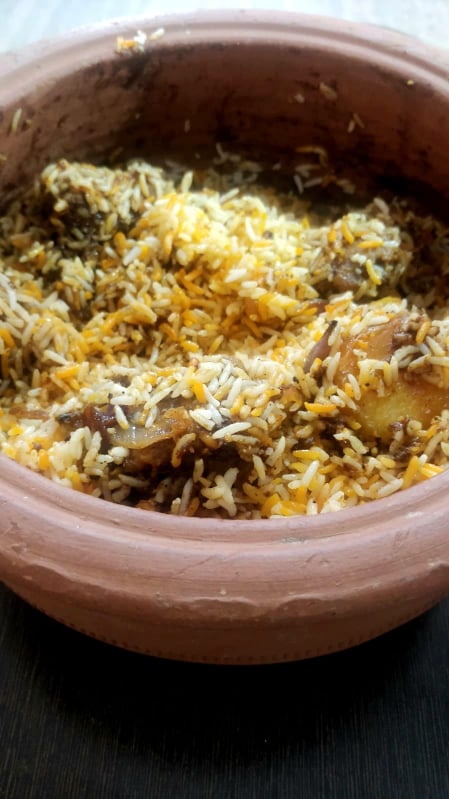
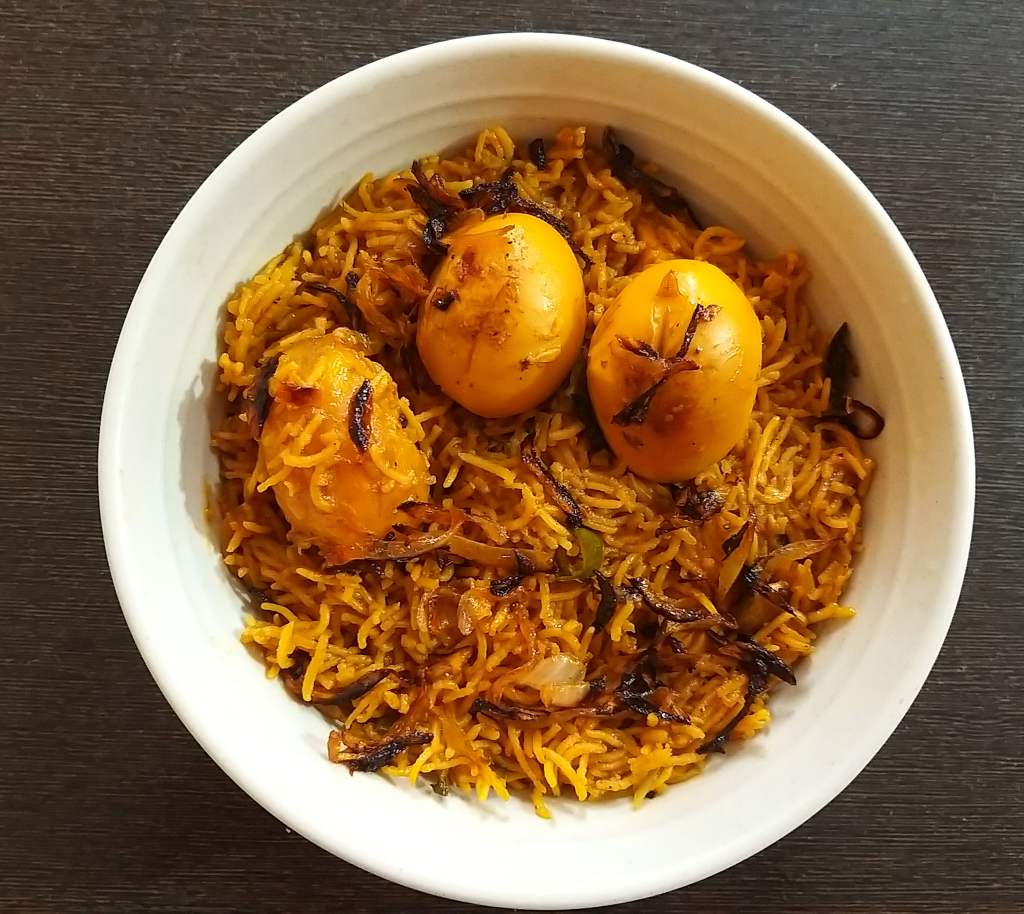
So, nipping all the dilemmas in the bud, I made Egg Tehari in a pressure cooker today. Added fried flavourful potatoes because why not! Serve it piping hot and eat your heart out.

Here is the recipe.

Ingredients:

  1. Boiled eggs: 4 nos.
  2. Boiled potatoes: 2 nos.
  3. Basmati Rice: 2 cups (soaked for 30 mins in water)
  4. Onions: 1 no.
  5. Garlic: 1 no.
  6. Ginger-Garlic Paste: 1 tbsp
  7. Bhuna garam masala: 2 tbsp
  8. Red Chilly powder: 2 tbsp
  9. Cumin-Coriander powder: 2 tbsp
  10. Pepper powder: 2 tbsp
  11. Curd: 4 tbsp
  12. Mustard oil: 4 tbsp
  13. Ghee: 2 tbsp
  14. Yellow food colour: 1 tsp mixed with milk/water
  15. Salt to taste
  16. Kewra water: 1 tsp
  17. Sugar: 1 tsp
  18. Tumeric powder: 2 tbsp
  19. Bay Leaves, cardamon, cloves, cinnamon: 2 each
  20. Green Chilly: 3 nos. (finely chopped)
  21. Coriander : 4-5 stems with leaves

Recipe:

  1. Smear the eggs and potatoes with salt, turmeric powder, red-chilly powder and yellow food colour and fried them in oil separately. Keep them aside.
  2. In the same pan, add julienne onions, sugar and fry them until golden brown and crispy. Keep it aside.
  3. In the pan, put bay leaves, cardamon, cloves and cinnamon.
  4. Add garlic, chopped green chilly, finely chopped coriander stems and fry until they release aroma.
  5. Add the ginger garlic paste and fry till the raw smell is gone.
  6. In a bowl mix all the above mentioned masalas with whisked curd and add to the gravy.
  7. One the masalas are cooked and release oil, add the fried potatoes and eggs and give it a good mix.
  8. Add half a litre of water and cook for another 5 minutes.
  9. Transfer all of the mixture into a pressure cooker and add the soaked rice.
  10. Adjust the seasoning.
  11. Add kewra water & fried onions (leave some for garnish).
  12. Place the eggs on top and potatoes below the rice.
  13. Seal the pressure cooker and cook it for 10 minutes.
  14. Serve hot it with coriander and fried onions.

If you liked this recipe and want to see more of this mother-daughter duo, don’t forget to reach out to us at rannabaati00@gmail.com and our Instagram Handle @rannabaati by Oliva Das. We look forward to your requests and feedback!
Extra-marital relationships (Part 1): Gatte ki Sabji

This is a food post, I swear.

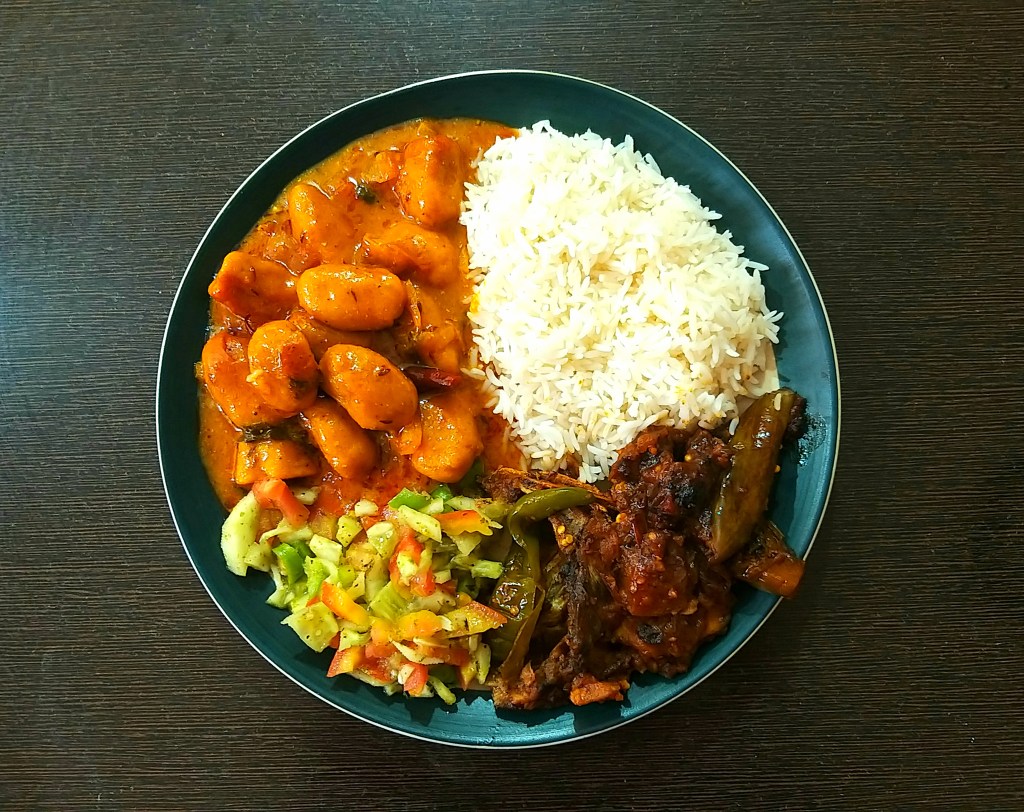
On my plate: Gatte ki Sabji, Steamed Rice, Kataa Chocchori, Kachumber Salad

Being a Bengali, the food-fetish is ingrained in me since I first knew how to eat probably. From Dhokaar Dalna to Bhapa Ilish, everyday at a Bengali household is a feast. It starts with teto (bitter like shukto, ucche bhaja) and ends with a mishti (like rosogolla). Today, however I write about a cuisine that I learnt to explore over time and eventually became my favourite.

I discovered Rajasthani cuisine when I was 13. I had moved to Tezpur from Dhubri (I stayed there for 3 years) and got called in for breakfast by Bharti (my best friend) on the day of Navami as her mother was celebrating Kumari Puja (A Hindu ritual carried out on Navratri to celebrate young girls as a form of Goddess Durga). I remember vividly Aunty serving me Puri, Aloo chola ki sabji, kadhi and boondiya. The Kadhi was so good that I kept licking my spoon asking for more. That is how I developed my favouritism for Rajasthani cuisine.

Aunty belongs to Mising tribe in Assam but she got married to a Rajasthani and that’s how she learnt to look Marwari food. During my engineering days, when I used to return to college post vacations, aunty used to make sure I take a dabba back to college full of gatte ki sabji so matter how busy she was. As embarrassed as this might sound, I used to finish it in Kolkata airport waiting for my connecting flight to Bhubaneswar.

Aunty’s way of making gatte ki sabji was very simple. Minimal masalas, a watery gravy (best served piping hot) and a distinct taste came from Asafoetida (hing) and pre-boiled potatoes crumbled with hands and dropping it into the gravy. Over time, my mother learnt how to make it from Bharti’r Maa (as she likes to call her), but Aunty’s gatte ki sabji was so subtle yet so nostalgic.

I make Gatte ki Sabji for the first time today. A tsunami of nostalgia kick in; how my Navami meant going to Bharti’s house for a hearty brunch after Durga Puja’r Anjali, Uncle’s (who is no more with us) last words to me, “Acche se rehna beta. Tum aur Bharti aise hi dosti rakhna apna!” never knowing that this would be his last words to me, Aunty’s innocent smile sitting and listening to our stories and me licking my fingers for more puri sabji.

… And that’s why friends, Rajasthani cuisine will always be my extra-marital relationship.

I served my Gatte ki Sabji with steamed rice, Kataa chocchori (A Bengali delicacy with fish head and vegetables) and Kachumber Salad (A Parsi salad with cucumber). Please note that I made my Gatta with a Dhokla mix as I ran out of Besan at home. It has baking soda in it and hence it turned out to be bigger in size. I would, however give you the exact proportions with besan as well.

Ingredients:

For making gatta:

  1. Besan/Gram flour: 300 gms
  2. Water
  3. Salt to taste
  4. Red chilly powder: 1 tsp
  5. Coriander powder: 1 tsp
  6. Cumin powder: 1 tsp
  7. Turmeric powder: 1 tsp
  8. Ajwain: 1 tbsp
  9. Curd: 50 gms

For making gravy:

  1. Cumin seeds: 2 tbsp
  2. Dried red chilly: 2 nos
  3. Hing: 1 tsp
  4. Onion: 1 nos. (Chopped)
  5. Tomato: 1/2 (Chopped)
  6. Green Chilly: 2 nos.
  7. Red chilly powder: 1 tsp
  8. Coriander powder: 1 tsp
  9. Cumin powder: 1 tsp
  10. Turmeric powder: 1 tsp
  11. Curd: 200 gms
  12. Salt to taste
  13. Mustard oil: 3 tbsp

Recipe:

  1. Mix all the ingredients for the gatte and make a stiff dough.
  2. Make thin cylindrical rolls from the dough and cut it into pieces.
  3. Boil them in water until the gatte float on top and are thoroughly cooked.
  4. In a kadhai, put mustard oil, cumin seeds, red chilly and hing.
  5. Fry the tomatoes and put salt and mix it properly. Wait for the tomatoes to get soft and mushy.
  6. Make a paste of all the masalas with water and add it into the kadhai.
  7. After it is fried and the raw smell is gone, add beaten curd into the masala.
  8. Wait for the oil to release and then add warm water into the kadhai.
  9. Lastly, add green chilies and gatta and cook it for 10 mins.
  10. Serve hot with steamed rice or roti.

If you liked this recipe and want to see more of this mother-daughter duo, don’t forget to reach out to us at rannabaati00@gmail.com and our Instagram Handle @rannabaati by Oliva Das. We look forward to your requests and feedback!
Netflix and ‘Chilies’ : Slow-cooked Sticky Bhoot Jolokia BBQ Drumsticks

Day before yesterday was a Sunday and I had indulged in late-night binge-watches as usual. Had to wake up early in the morning because my kitchen sink had stopped working and needed plumbing services. It was quite a hectic Sunday and I knew Monday is going to be more stressful with work resuming, household chores, cooking and managing a plumber in the lockdown. Also, there was a persistent tension as to how I am going to let a stranger in in this pandemic situation, maintain distance and manage everything else – my mind was a chaos.

Nevertheless, I managed to contact a plumber, thanks to my landlord and asked the plumber about his health conditions, confirmed he’s well and asked him to visit. Woke up early morning just when the plumber rang the bell. I opened the door and made him sanitize his hands in a jiffy, asked him to keep the shoes out and step in. Thankfully, he wore a mask and was very particular about his hygiene and repeatedly washed his hands after cleaning the sink pipe and I was relieved. He was done in 30 minutes and after he was gone, I cleaned my door knobs to make sure everything is clean and sanitized.

I was tired. Inadequate sleep, fatigue, uninterrupted paranoia and the fear of “What should I cook now?” made me… go to sleep. Yes, that’s how I apparently deal with problems, by sleeping it off. Don’t we all though? Anyway I woke up to the sound of a kid walking in the neighborhood with his quack-quack shoes which are not cute btw, especially when you are trying to sleep!

I wake up, I am tired AND hungry. I head to my kitchen with a headache and think of cooking something EXTREMELY hassle-free. A few months before, I watched a Marion Grasby recipe of Sticky Asian BBQ Wings in a slow-cooker and decided to give it a try by giving my own twist. It’s oil-free, sticky, sweet, spicy and the best part is the meat falls off the bone just like that and make you go weak in the knees with the heat!

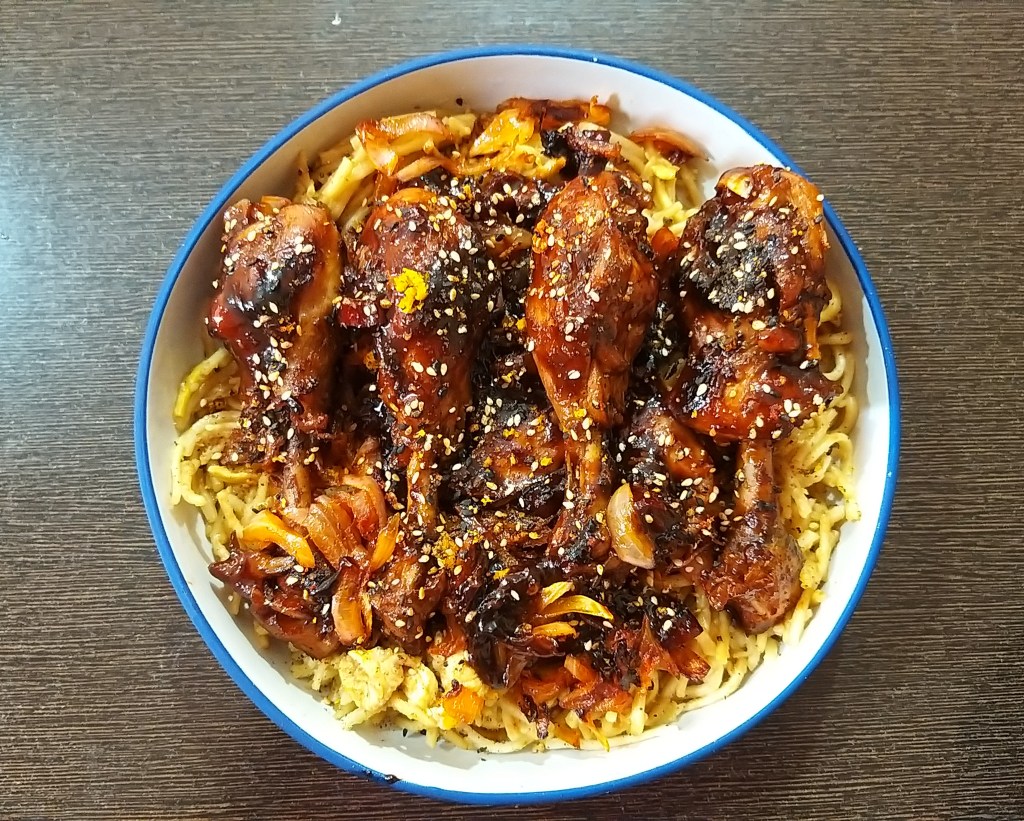
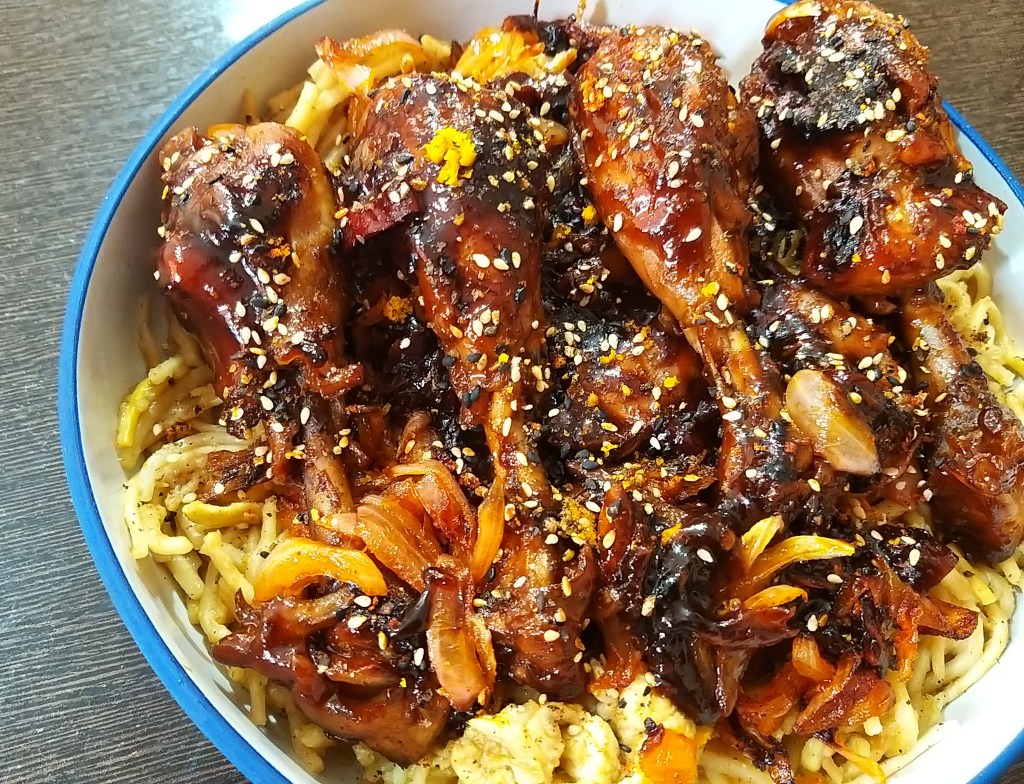
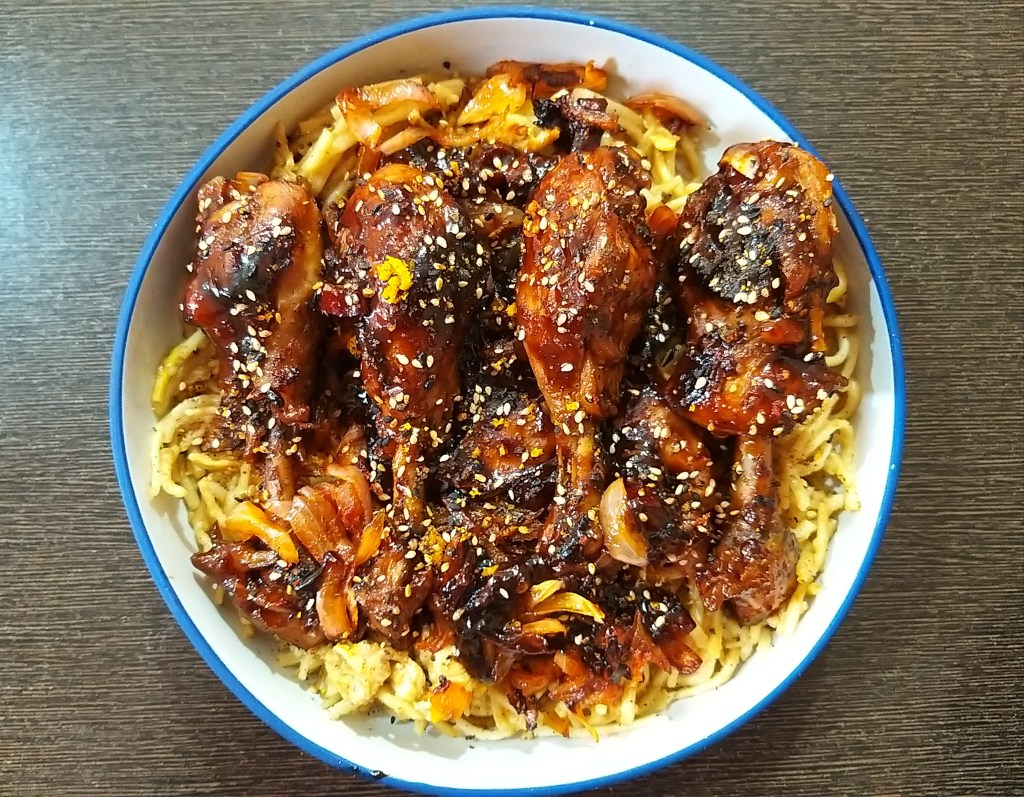
I served it on a bed of egg stir fry noodles (a usual recipe you can get online) and grilled onions and topped the drumsticks with an amazing spice mix. Let’s have a look at the recipe!

Ingredients:

  1. Chicken legs: 4 pieces
  2. Bhoot Jolokia sauce/paste: 6 tbsp
  3. Schezwan sauce: 2 tbsp
  4. Tomato sauce: 4 tbsp
  5. Sweet Chili sauce: 4 tbsp
  6. Pickled red paprika (optional, sliced): 2 tsp
  7. Soya Sauce: 1 small cup
  8. Jaggery: 3 tbsp
  9. Honey: 3 tbsp
  10. Salt to taste

For the topping:

  1. White sesame seeds: 2 tsp
  2. Black sesame seeds: 2 tsp
  3. Orange rind: 1/2 tsp
  4. Lemon rind: 1/2 tsp
  5. Pepper powder: 1 tsp
  6. Salt: A pinch
  7. Red chili powder: 1/2 tsp

Recipe:

  1. In a slow-cooker/saucepan, add all the ingredients and give it a hearty mix.
  2. Let it cook in a medium-low heat with occasional stirring for an hour. The meat must fall of the bones almost and that’s how you know it is done.
  3. If you think that the consitency is not as you desired, then add warm water and heat it to make it a little runny or add a tsp of wheat flour in the sauce to make it stickier.
  4. Roast all the ingredients for the topping lightly (except the orange and lemon rind) and lightly coarse it. Mix it with the rinds and assemble.

Assembly:

  1. Put a bed of chowmein prepared of your choice. I would suggest to keep it light and less spicy as it should overpower the taste of the chicken.
  2. Then put some grilled onions on top, and then layer with the sticky braised sauce.
  3. Add some more grilled onions on the sides and place the chicken drumsticks.
  4. Top it with the topping mixture and serve hot.

If you liked this recipe and want to see more of this mother-daughter duo, don’t forget to reach out to us at rannabaati00@gmail.com and our Instagram Handle @rannabaati by Oliva Das. We look forward to your requests and feedback!
Maa’r Robibaarer Murgir Jhol – Sunday Chicken Curry

IT’S A THING! Yes, you heard me right. Runny consistency yet a dark-oily chicken curry on Sundays with Sadaa Bhaat (Steamed Rice) is a thing in Bengalis. Well, of course Kochi Patha’r Jhol or Mutton Curry always steals the show on Sundays but some days when Maa feels that Maangsho (in Bengalis, we generally term Maangsho/Meat as Mutton by default, Chicken gets called as Murgi) consumption gets over the top, Baba tones it town by bringing fresh chicken from Chowk Bazar (in my hometown) early morning and screams from the gate in joy,

Suparna! Aajke jaa tazaa murgi pelam naa!”

(Suparna, I got you fresh chicken today!)

Maa cooks the chicken on dum with all the ingredients, minimal masalas but a lot of mustard oil forms a perfect marriage. An occasional naraa-choraa (mixing) in the hnaari (saucepan) and a continuous slow low flame cooking is the secret to her simple yet so mouth-smacking chicken curry.

A huge shoutout to my Kaku (uncle) who makes the best chicken curry in the world! Runny gravy yet dark-flavoured oil and fats from the chicken floating on top.

So, anyway I call my mom today and ask her patent chicken curry recipe and cook in it a maatir hnaari (clay pot) on dum. The earthy smell of the curry and slightly charred chicken legs were to die for! I enjoyed it with steamed rice and Aam’er tok (Mango chutney).

Robibaarer Maati’r Hnaari’r Murgir Jhol cooked on Dum

Ingredients:

  1. Chicken – 500 gms
  2. Onion – 1 nos.
  3. Onion paste – 1 nos.
  4. Ginger-Garlic paste – 2 tbsp
  5. Coriander powder – 1/2 tbsp
  6. Cumin powder – 1/2 tbsp
  7. Red Chili powder – 2 tbsp
  8. Pepper (Roasted and coarsely grounded) – 1 tbsp
  9. Curd – 3 tbsp
  10. Salt to taste
  11. Sugar – 1 tbsp
  12. Potatoes – 2 nos.
  13. Garam Masala powder – 2 tbsp
  14. Bay leaves – 2 nos
  15. Mustard oil – 5 tbsp

Recipe:

  • Marinate the washed and soaked chicken with yogurt, all the ingredients and massage all the pieces thoroughly and rest it for an hour (3 hours if you want best results) . Keep half of the julienne onions for frying aside.
  • Optional: Fry the marinated potatoes in mustard oil and keep it aside.
  • In the same pot, add 2 bay leaves, julienne onions and sugar and fry till the onions are golden brown.
  • Once the onions are fried, add the marinated chicken and fried potatoes and mix all the ingredients properly with the oil.
  • Put the chicken on dum by covering it with an air-tight lid or seal the pot with foil paper and a lid and let it cook until oil starts separating from the masalas on the sides and the chicken and potatoes are cooked. Mine took an hour. Stir it occasionally.
  • Add warm water once the chicken is cooked (kosha). Add salt and sugar to your taste.
  • Add the freshly grounded pepper powder at this point and let it cook for another 15 minutes.
  • Once it’s ready, serve your Sunday Chicekn curry with steamed rice, gondhoraj lebu (kaffir limes) and kaacha pyaaz (onions).

If you liked this recipe and want to see more of this mother-daughter duo, don’t forget to reach out to us at rannabaati00@gmail.com and our Instagram Handle @rannabaati by Oliva Das. We look forward to your requests and feedback!
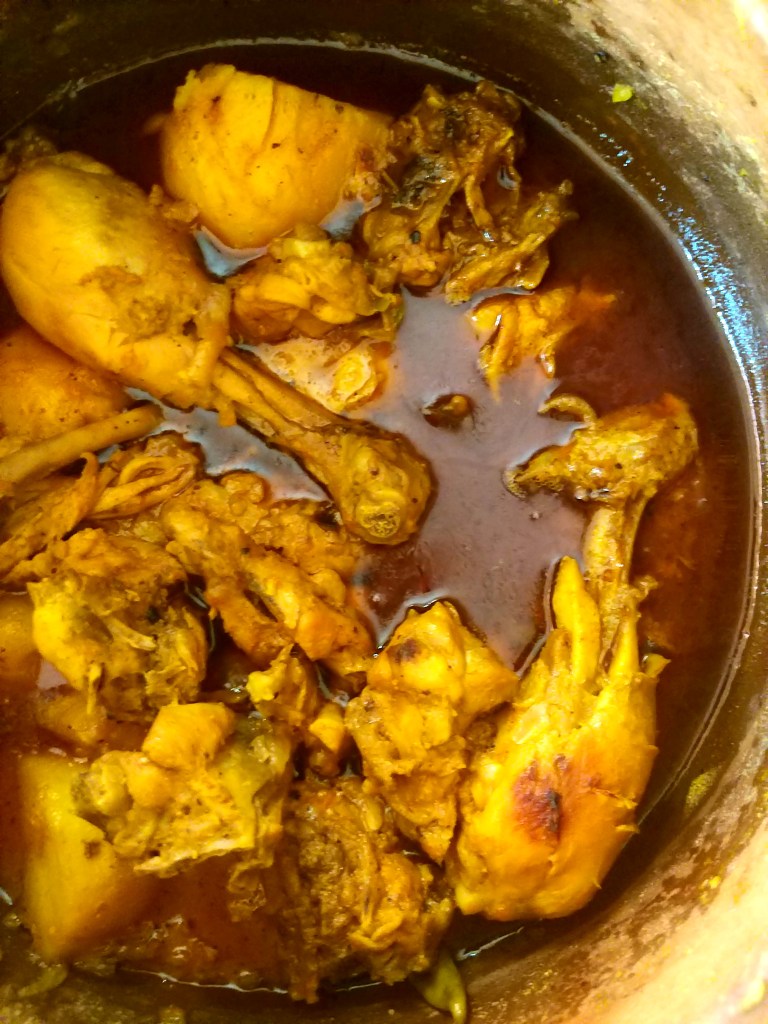
A woman of “culture” makes yogurt at home.

Geddit? Geddit? I like to make yogurt at home so I am a woman of “culture” because yogurt – culture? No? Bad joke? Ok.

So your lady tried making yogurt at home for the first time and Boy! I.am.never.going.back.to.store.bought.curd.

It was thick, white and dense unlike the store-bought ones.

Also, grocery shopping in this lockdown is a pain in the ass and Man! Where are all the curds going? What are people doing with it? Why are they OUT OF STOCK? Guess, we will never know, will we? Hence, homemade curd.

Few tips:

  1. I have been told to use full-fat milk though it was not available and I used toned milk and it turned out great, so, yeah.
  2. Mix the curd (starter) in the milk only when warm to get the perfect consistency. It is very important as too hot or too cold milk can either make the curd watery/runny or the curd might not form.
  3. If you do not have curd as a starter, you can use an unbroken red chili, that works as well.
  4. Simmer the milk until it comes to full boil in medium heat and then put it on low heat and simmer it for 10-15 minutes. Warm it down to mix the curd.
  5. If you are using curd as a starter, make sure you whisk it thoroughly and then mix with the milk evenly for an even distribution.
  6. Store in a warm place and I kept it for 19 hours and the curd was fully set. Ideally, it is asked to keep overnight but I kept a little longer.
  7. Store it in a terracotta/aluminium/steel vessel and close it with a lid.
  8. Don’t open the lid frequently.

Ingredients:

  1. Milk (Full-Fat/Toned) : 1/2 kg
  2. Curd (As a starter): 1 tsp

Recipe:

  1. Boil the milk in a saucepan.
  2. Simmer the milk until it comes to full boil in medium heat and then put it on low heat and simmer it for 10-15 minutes. Warm it down to mix the curd.
  3. Once it is warm (test it by dipping your finger), mix the whisked curd to the milk evenly so that there is even distribution.
  4. Transfer it to a vessel and keep it in a warm place with closed lid overnight.
  5. Yogurt is ready.

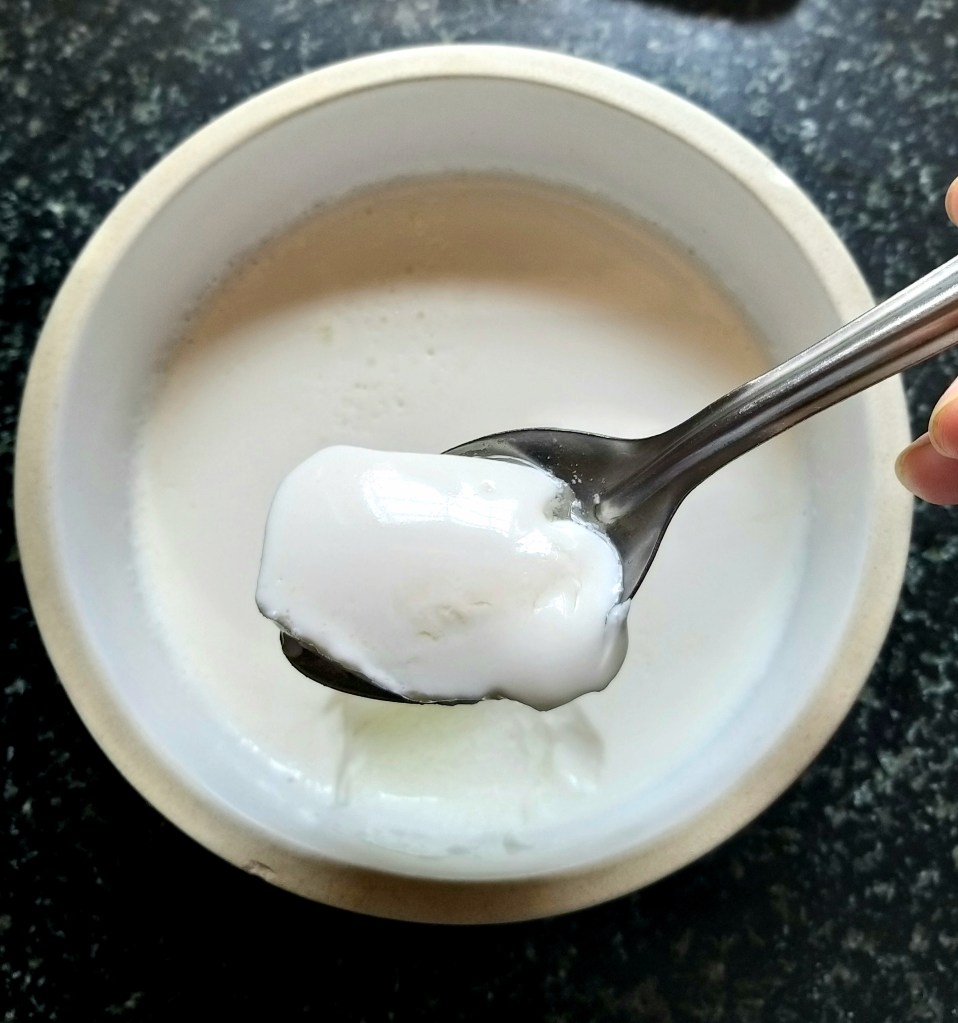
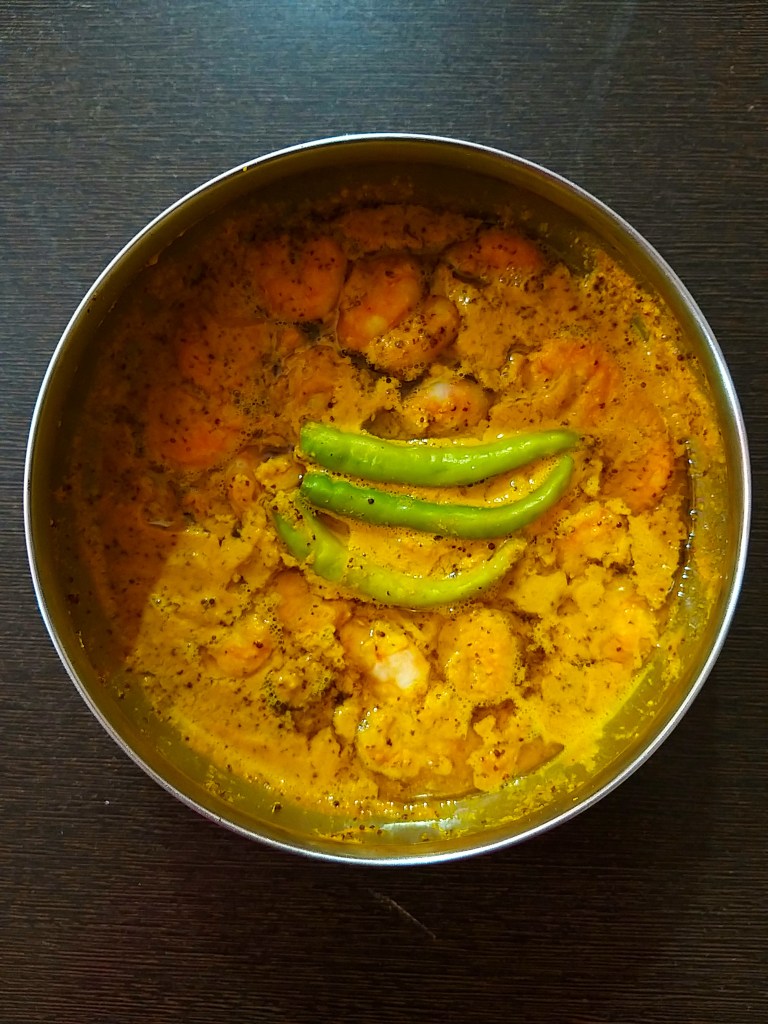
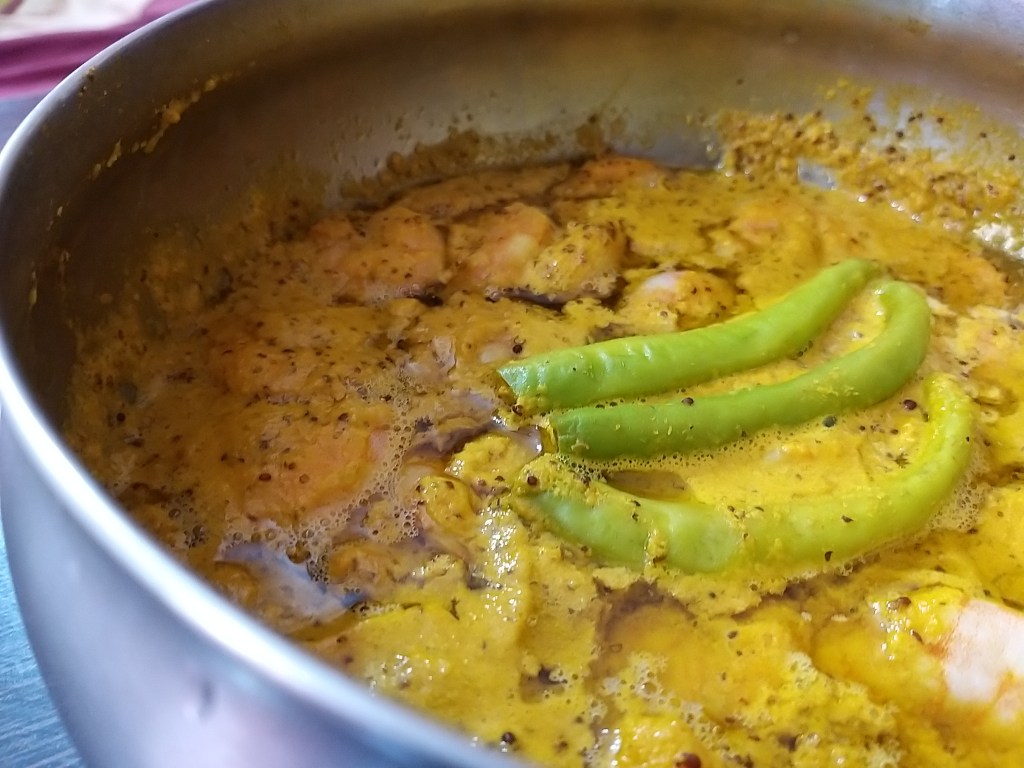
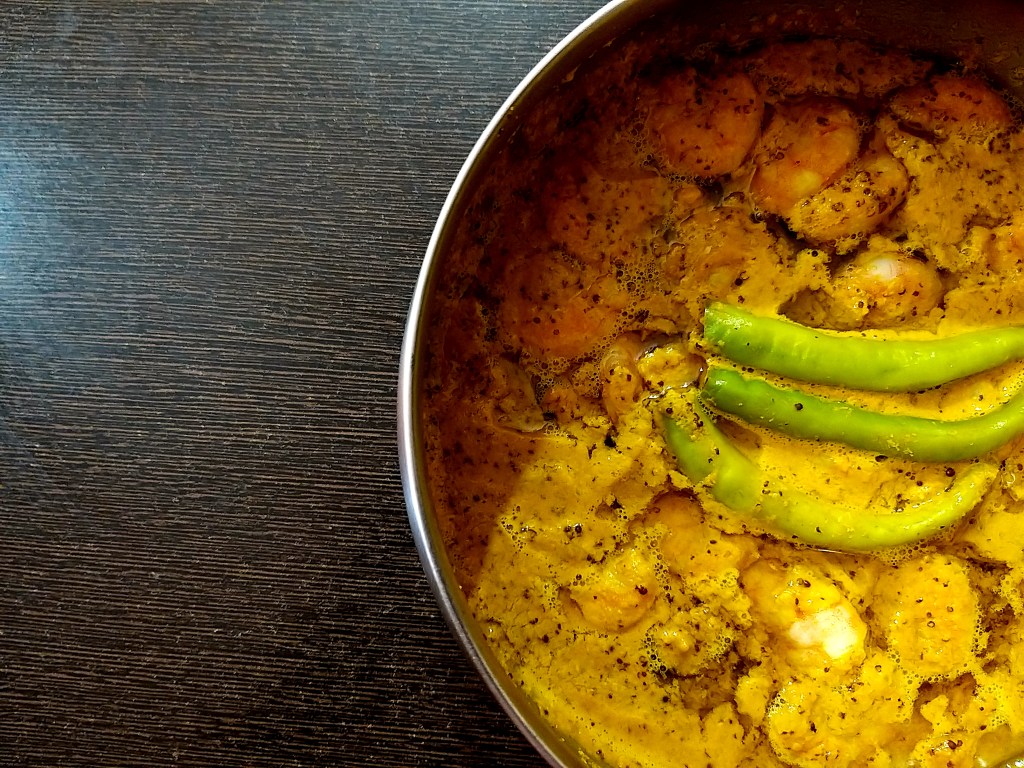
The steam ‘rose’ to the occasion – Shorshe Narkel Bhapa Chingri

Shorshe Narkel Chingri

There is something about a long day of work meetings and then facing the empty fridge that makes us sulk (thanks to adulthood!) and reach our phones to ‘Swiggy It!’ or surf Zomato to order food from restaurants or as Maa would like to say, “Jotoshob baaje khabaar (All junk food!)!”. Thanks to the lockdown, even that seems impossible now. I juggle between two office meetings from home and in a 15 minutes hiatus call my Mom in despair,

Maa! Dhur bhaal laage na, Chingri aache but banaanor ekdom shomoy nei.”

(Mom! Adulting sucks! There’re prawns in my fridge but I have no time to cook!)

“Arey chingri olpo bhaja korlei toh hoi… Olpo jeera bata, aloo diye jhol baniye ne.”

(Oh prawns don’t need much frying, make a cumin paste slurry, add potatoes and your gravy is done!)

“But Maa, amar ekdom ranna korte icche korche na, fry koraro time nei”

(Mom, but I don’t feel like cooking at all! I don’t have time for frying as well)

“Uff, tahole bhapa kore ne aar phone taa rakh. Unlike you, I don’t have time to sulk!”

(God, just steam the fish then! Unlike you, I don’t have time to sulk!)

Savage mother hung up on me, but left me with a good idea. Chingri maach bhapa is an all-time favourite and reminds me of good ol’ afternoon lunches where my eyes would lit up when Maa used to make them and open the lid at lunch, the steam “rose” to the occasion and the pungent aroma reached your nose and gives you a slight tickle, “jhaaj” we call it in Bengali.

The memories of childhood afternoons weaving my work from homes, this Shorshe Narkel Chingri Bhapa is steamy, musky, aromatic and all things good. Let’s have a look at the recipe.

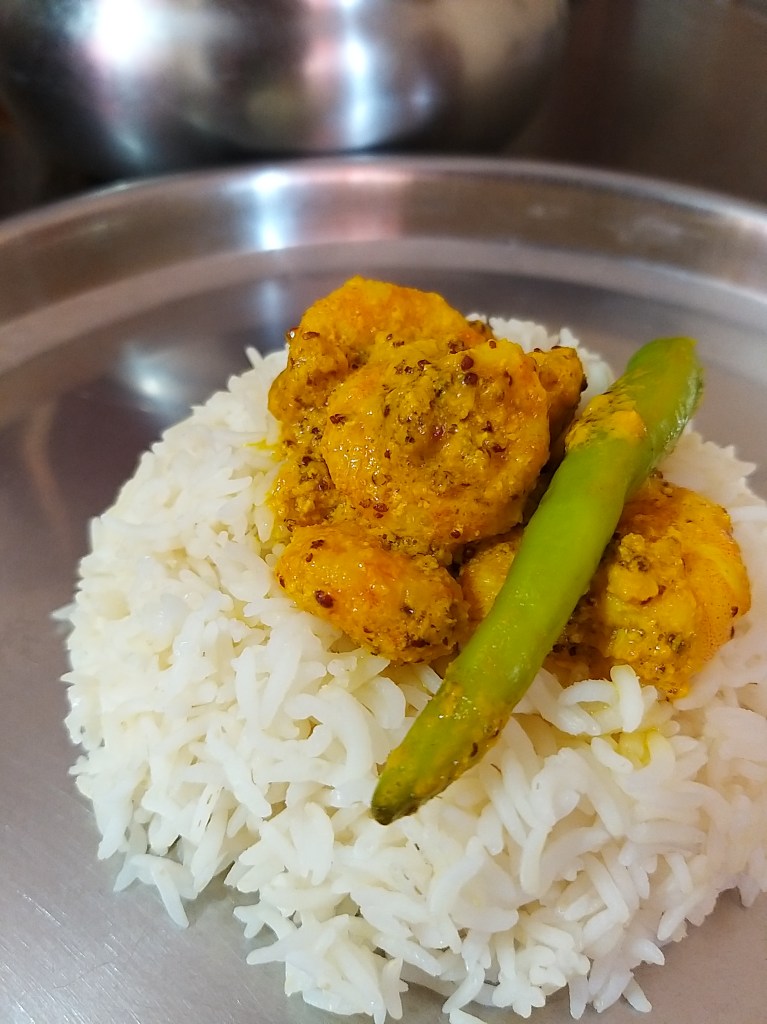
Sadaa Bhaat and Bhapa Chingri : Match made in Heaven
Sir, Sir… One lower shot Sir! Double Chin need to show Sir!

Ingredients:

  1. Prawns: 500 gms (Cleaned, de-veined and de-shelled)
  2. Black Mustard: 3 tbsp
  3. Yellow Mustard: 2 tbsp
  4. Desiccated coconut: 2 tbsp
  5. Green chilies: 5 nos.
  6. Turmeric: 3 tsp (I used more turmeric for colour but compensated it by steaming it for longer period of time. Check the recipe for the details)
  7. Yogurt: 2 tbsp
  8. Salt to taste
  9. Sugar: a pinch
  10. Mustard Oil: 4 tsp

Recipe:

  1. Wash the prawns in clean water and dry them with a clean cloth or paper towel.
  2. Put the prawns in a steel tiffin box (with lid) and add three green chilies to it.
  3. Meanwhile soak the other ingredients (except mustard oil, yogurt, salt and sugar) in 2 tsp of water and let it rest for 15-20 minutes.
  4. In a blender, add the soaked ingredients, salt, sugar, yogurt and a dash of mustard oil and make a smooth paste. Remember to not make it runny, add water accordingly.
  5. Add the paste into the prawns and mix thoroughly.
  6. Add a dash of mustard oil.
  7. Take a kadhai and add water into it and put it to boil.
  8. Close the lid of the tiffin-box and place it on the kadhai and dip 1/4 of the box into the kadhai.
  9. Let it steam for 30 mins for the best results.
  10. Serve hot with steamed rice.

If you liked this recipe and want to see more of this mother-daughter duo, don’t forget to reach out to us at rannabaati00@gmail.com and our Instagram Handle @rannabaati by Oliva Das. We look forward to your requests and feedback!
Ekla Boisakh – A sorrower’s guide to acing the lockdown in festivities alone

Poila Boisakh a.k.a. Bengali New Year has always been an important day in every Bengali household. Gorging my way through an array of pithe-puli and wearing notun jama-kaapor is what I remember as the new start of the year beckons.


In my childhood days in Assam, convent schools didn’t prioritize Bengali festivals but luckily it coincides with Rongali Bihu, hence a holiday. Early morning Ma dragged me out of bed, be in full cry about how my cousins had already gotten ready and had visited the temple and make a big deal out of nowhere.

Lazy since inside mother’s womb, I showed Maa by I-am-awake-now face and slyly passed away to take one more short nap till I got caught again.

Cousins then came (kids with new snow-white tape-jama), climbed over me and appreciating their consistency and hard-work, I used to wake up, take a bath, dress up in fresh new cotton dress and visit the temple, then eat Bengali delicacies with the entire family together.


Such used to be a typical Poila Boisakh.
Over the last few years away from home, my Poila Boisakh meant visiting restaurants serving Bengali cuisine with my bengali friends since college. Every year, like a tradition.

However, at this time when the entire Bengali community should be celebrating the commencement of a new harvest, celebrate a new beginning and dig into delicacies with their friends and families, sadly, the country is seeing the Poila Boisakh celebrations having a slow death because of the unsettled times that we are living in.

The truth is what the truth is. It is oddly satisfying to know that we are all in the same boat today. We can only find cracks in these times for the sunlight to beam in so that we can make the best out of this situation.

12’o clock I peep into my refrigerator for what’s available, take the last batch of chicken I had saved for the best and decide to cook it.

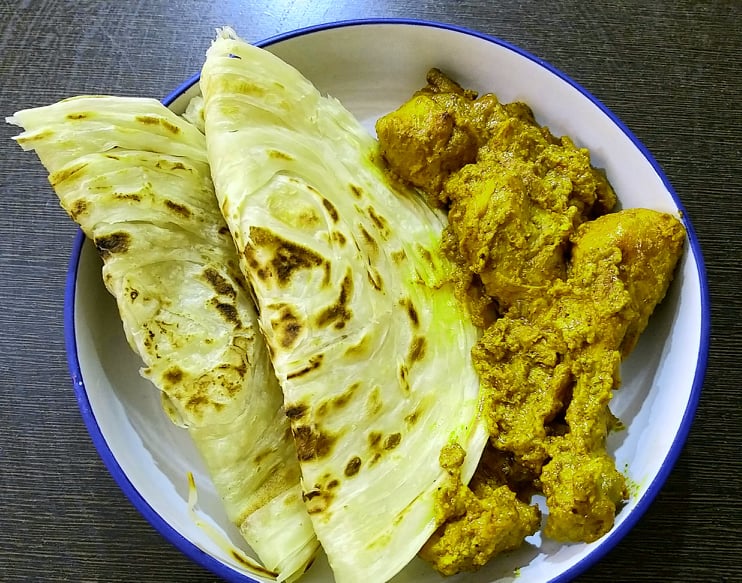
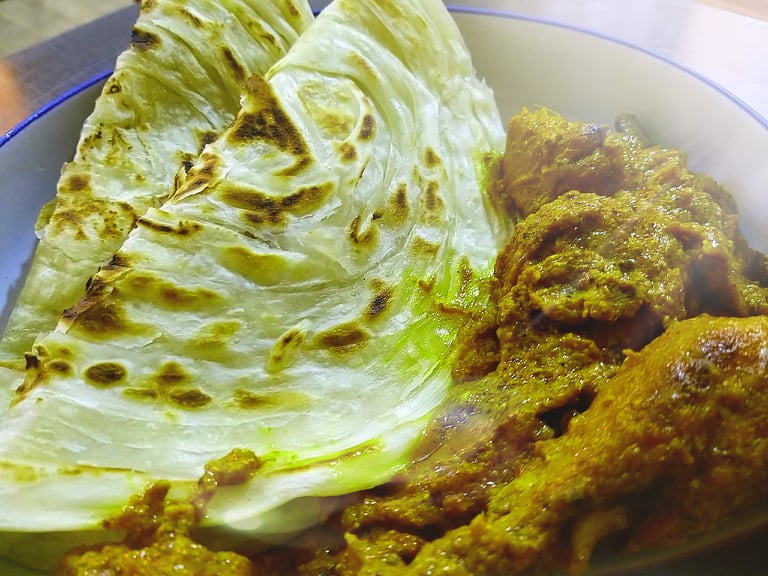
Inspired from the traditional recipe of Chicken Chaap, succulent chicken pieces wrapped in rich, lustrous gravy with its special taste from almonds and chaar magaz (melon seeds), I decided to name this chicken as Badami Chicken. Served with Laccha Paratha, it was an absolute delight.

Badami Chicken with Laccha Paratha

Here’s the recipe of Badami Chicken for you all.

Ingredients:

  1. Chicken: 300 gms
  2. Desiccated coconut: 3 tbsp
  3. Almonds (soaked in water): 5-6 nos.
  4. Melon seeds (soaked in water): 3 tbsp
  5. Cashew nuts (soaked in water): 7-8 nos.
  6. Poppy seeds (soaked in water): 3-4 tbsp
  7. Onion paste: 1 whole onion
  8. Ginger Garlic Paste: 2 tbsp
  9. Besan (Gram flour): 4 tbsp
  10. Shahi Garam Masala/Biryani Masala: 4-5 tsp
  11. Kashmiri Chilli Powder: 1 tbsp
  12. Turmeric powder: 1 tbsp
  13. Yogurt: 1 cup
  14. Rose water: 1 tbsp
  15. Kewra water: 1 tbsp
  16. Saffron infused in warm milk/Saffron food colour in warm milk: 2 tbsp
  17. Salt to taste
  18. Refined oil: 5 tbsp
  19. Ghee: 2 tbsp

Recipe:

  1. Wash the chicken pieces thoroughly and make 2-3 slits in each piece for the marination to penetrate inside.
  2. Make a thick paste of soaked almonds, cashew, coconut, melon & poppy seeds and rest of the ingredients (except oil and ghee) and add in to marinate the chicken.
  3. Massage the chicken pieces thoroughly so that the marinade penetrates into the chicken pieces; it would make the chicken more moist and succulent.
  4. Cover the bowl and marinade it inside the refrigerator for an hour or more depending on the time you have. 1 hour would do just fine too.
  5. In a large deep-bottomed pan, pour the oil and ghee and throw in the chicken pieces after brushing off the excess marinade and fry till it light-golden in colour.
  6. Take the pieces out once fried and in the same oil, add the rest of the marination and cook until oil separates from the sides and the raw smell is gone.
  7. Add the chicken pieces and mix well.
  8. Add warm water for gravy if necessary to get the desired consistency.
  9. Serve the Badami Chicken with Laccha/Malabar Paratha or Mutton Biryani with a bottle of Coke and salad.

If you liked this recipe and want to see more of this mother-daughter duo, don’t forget to reach out to us at rannabaati00@gmail.com and our Instagram Handle @rannabaati by Oliva Das. We look forward to your requests and feedback!
Best out of less – Fish biryani

It is lockdown time, people!

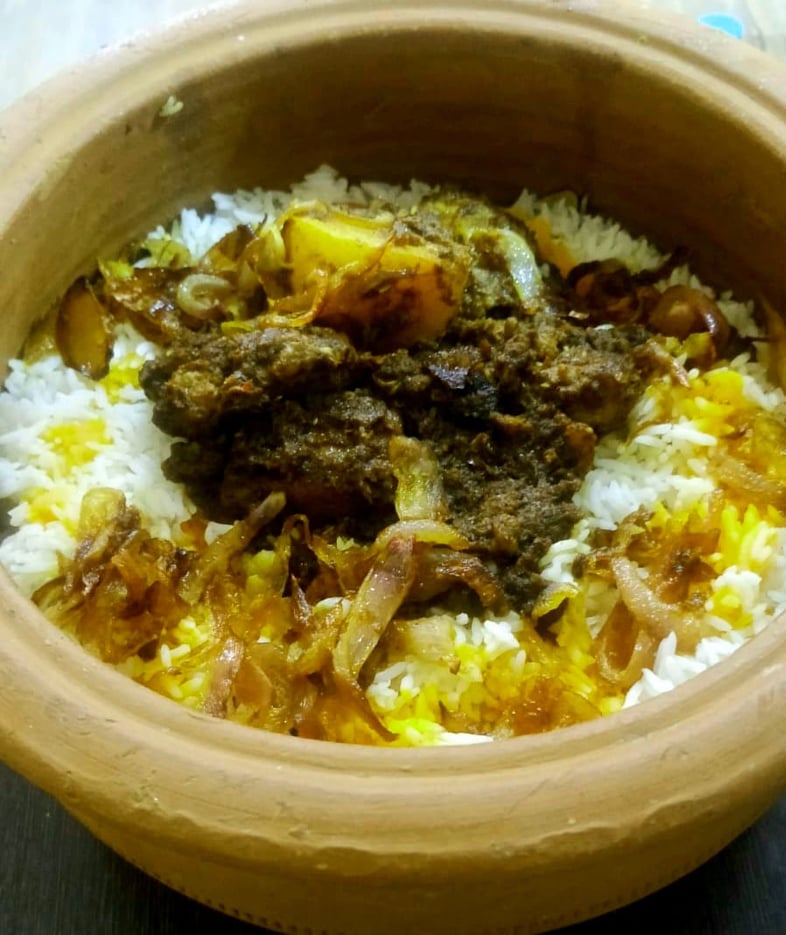
Wow, in my head it sounds a recess in school but we all know how severely we are willing to get out of this recess. Anyway, so it was weekend until yesterday and I binged-watched all the seasons of Money Heist (all the four), hence my sleep was obviously at a toss. Woke up at 2 in the afternoon hungry, exhausted from all the uneven sleeping, I thought to myself, “Only a good lunch can solve this!”. I visit my kitchen, rummage through my pantry only to see that most of the fancy items have exhausted. My mind screams “Biryani!” but reality seemed otherwise. No basmati rice, no curd, a couple of chilies on the verge of losing its freshness AND a lot less hope. Left with no other option and my mind refusing to give up, I decided to make a less fussy Fish Biryani in a clay pot. I could not manage to take good pictures of the biryani as it was pretty late by the time I finished cooking and my stomach was growling.

This biryani recipe is flexible, because there’s a lot you can do with a few staples in your pantry. Try making this at home when you are not working or are relatively free and you would not regret.

I hope you like it!

Fish biryani

Ingredients:

Sri-Lankan Fish Fry Masala:

  1. 5-6 Dry red chillies
  2. 2 tbsp Ginger powder
  3. 1 tbsp Sauf/Fennel Seeds
  4. 1 tbsp Haldi/Turmeric powder
  5. 1 tbsp Black pepper
  6. 1 tbsp cloves
  7. 1 tbsp Jeera/cumin seeds
  8. 1/2 inch stick Cinnamon
  9. 2 tbsp lime juice or Vinegar
  10. Pinch of sugar
  11. salt to taste

Fish fry:

  1. Basa/Bhetki (Any kind of boneless fish) : 6-7 pieces
  2. Salt and Pepper to taste
  3. Sri Lankan fish fry spice mix (dry-roasted and freshly grounded): 4 tbsp
  4. Refined wheat flour (Maida) to coat the fish
  5. Mustard oil – 2 tsp

Biryani Masala (can be bought or made at home):

  1. Black cardamom / Badi elaichi – 4 nos.
  2. Green cardamom / Elaichi – 4 nos.
  3. Bay Leaf – 2 nos.
  4. Coriander seeds – 2 tbsp
  5. Cumin seeds – 2 tbsp
  6. Caraway seeds/ Shahi jeera – 2 tsp
  7. Mace / Javitri – 4 nos.
  8. Cinnamon stick / dalchini – 2 inch
  9. Nutmeg / jaayaphal – 1 nos.
  10. Cloves / lavang – 1 tsp
  11. Star anise / chakkar phool – 2 nos.
  12. Pepper / kali mirch – 4 tbsp
  13. Fennel / saunf – 2 tbsp
  14. Turmeric / haldi – 1 tsp
  15. Dry red chillies – 4 nos.

Biryani rice:

  1. Basmati rice (I had sona masoori so I used that, turned out well but basmati is preferable): 3 cups
  2. A potli of dry roasted whole garam masala spices/ biryani masala: 3 tbsp
  3. Salt to taste

Berista:

  1. Leftover fried fish oil (Add some more oil if necessary)
  2. Onions: 4 nos.
  3. Red chili powder: 3 tsp
  4. Sugar: 1 tbsp
  5. Salt: 1 tsp

Fish gravy/masala:

  1. Fried fish
  2. Mustard oil: 4 tbsp
  3. Ginger-garlic paste: 1.5 tbsp
  4. Onion paste: 1 nos.
  5. Chili paste (I’ve used green chili, mathania chili (used for colour), Teja Red Chili (used for spice); you can use any chili that gives of the combination of these 3. Boiled it in water and made a paste)
  6. Coriander powder: 2 tsp
  7. Cumin powder: 2 tsp
  8. Red chilli powder: 2 tsp
  9. Pepper powder: 1 tsp
  10. Sri Lankan Fish fry powder: 4 tbsp
  11. Biryani masala: 2 tbsp
  12. Salt to taste
  13. Sugar: 1 tsp
  14. Lemon juice: 2 tsp

Biryani Assembly:

  1. Fried potato: 1 nos (Boiled first, then smeared in turmeric, salt, red chili powder and a pinch of yellow food colour and then fried in oil)
  2. Yellow food colour: 1 tsp soaked in water
  3. Kewra water & Rose water: 3 drops each
  4. Ghee (Melted)
  5. Prunes/ Aloo Bukhara (optional)

Recipe:

  1. Marinate the fish with all the fish-fry ingredients except for flour and keep it aside for 15-20 minutes.
  2. Coat the fish with flour and drain of the excess when you’re about to fry.
  3. Heat oil in a pan and pan fry the fish pieces. Keep it aside.
  4. In the same oil, drop the spices for beresta except for salt and sugar and wait for the oil to turn dark in colour.
  5. Drop the onion julienne and immediately put salt and sugar, mix it properly and let it fry till the onions are golden-brown in colour. Keep it aside.
  6. Fry the potato and keep it aside.
  7. In the same oil, drop all the dry masalas and let it fry for a min.
  8. Add the ginger-garlic paste and then the onion paste and fry till the raw smell goes off.
  9. Once everything is cooked, add the chili paste and cook until the gravy leaves oil on the edges.
  10. Add salt and sugar.
  11. Add the fried fish (don’t forget the drippings!).
  12. Add lemon juice at last and keep it aside.
  13. Meanwhile, cook the rice at 90% with biryani masala and drain off the water.
  14. To assemble the biryani, in a clay pot, add bay leaves in the bottom to prevent the biryani from burning.
  15. Smear ghee on the bottom and the sides and put 1 part of the cooked rice.
  16. Add 1 part of the fish gravy, beresta, ghee and yellow food colour solution on the sides, biryani masala and repeat 3 layers of the same.
  17. Top the layered biryani with the rest of the beresta, ghee and yellow food colour.
  18. Sealed the clay pot with a foil paper or with a wheat dough and a lid.
  19. Keep it on low heat for 30 mins and serve hot.

If you liked this recipe and want to see more of this mother-daughter duo, don’t forget to reach out to us at rannabaati00@gmail.com and our Instagram Handle @rannabaati by Oliva Das. We look forward to your requests and feedback!
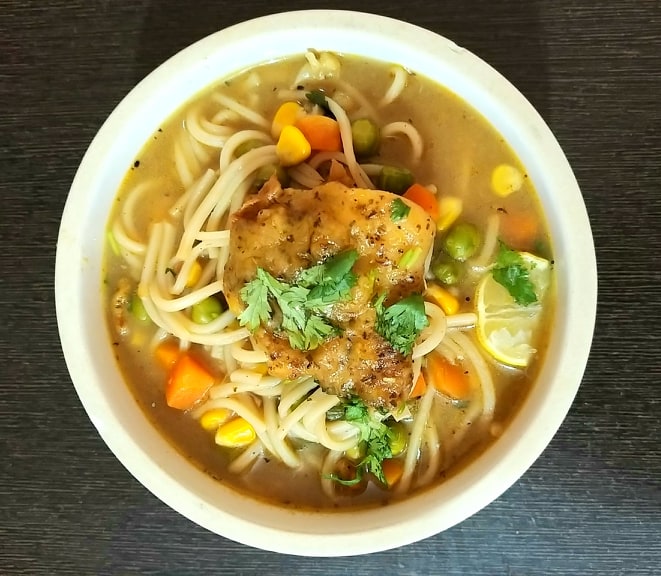
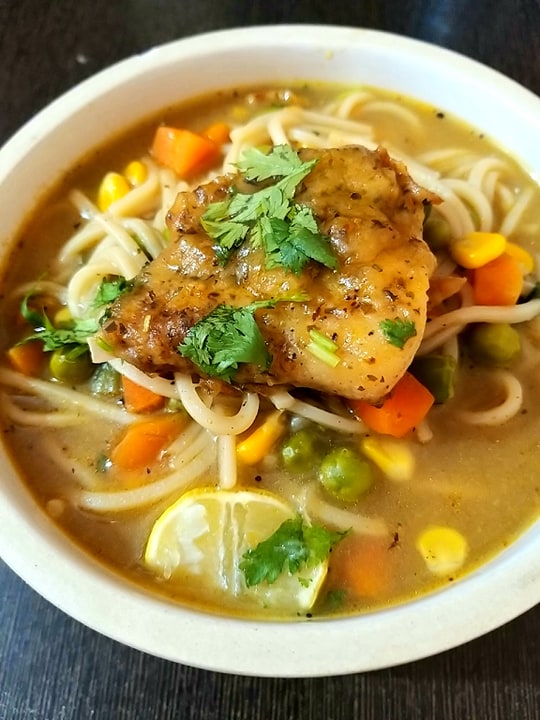
Quarantine cooking (Not your regular bat soup): Veg Thukpa and Orange-glazed ginger fish

Covid-19 lockdown is every introverts’ wet dream, they say. Three weeks down, I working from home and life isn’t any different for me, I used to run the world from my bed avoiding people, I still do. What changed is that my hands feel like sandpaper now from all the washing. Also, cleaning has gotten a new dimension, “Not just clean, Monica clean.” What also changed is the crippling anxiety from within and the eerie silence of the Bangalore roads. It’s unusual and what bothers me is the non-consensual idea of me staying at home (Previously, it was my choice to stay at home and avoid people, universe didn’t have to shove it down on me!). Well, what can you do, “Tell them the paint is wet, and they have to touch it to be sure”. Forgive me, if I’m diluting the significance of this issue, like Chandler, “I make jokes when I am uncomfortable”. All jokes apart, I am worried about the current situation and honestly, cooking helps.

So, I would jot down two easy-peasy recipes for you to cook during your quarantine days and stock it up for the next day as well, so it saves the time (but what are you gonna do with all these time, anyway hehehe. sorry.)

Vegetable Thukpa with Orange-Glazed Ginger Fish
Madam, side-angle photo please Madam!

First up, Vegetable Thukpa!

Ingredients:

  1. Veg Hakka Noodles (1/2 packet)
  2. Carrot – 2 nos.
  3. American Corn – 1 cup
  4. Beans – (4/5)
  5. Cauliflower – 6-7 florets
  6. Peas – 1 cup
  7. At this point I would like to tell you that you can use whatever vegetable you like.
  8. Garlic – (5 cloves finely chopped)
  9. Veg/Chicken Cube Stock (Use Dal water or Boiled water if not available. I used Maggi Chicken Stock Cubes)
  10. Tomato puree/Manchow Soup mix/Schezwan sauce (Listen girl, you do you alright)
  11. Butter
  12. Lemon Juice (2 tsp)
  13. Spring onions
  14. Ginger Garlic paste (2 tbsp)
  15. Salt and pepper as per taste
  16. Butter – 1 tbsp

Recipe:

  1. Heat refined oil and butter in a wok.
  2. Once hot, add the chopped garlic and saute it until golden brown.
  3. Add the ginger garlic paste and saute until the raw smell disappears.
  4. Add in all the vegetables and saute it until it’s lightly fried. The colour and the texture of the vegetables should not change.
  5. Now add in the Tomato puree/Manchow Soup mix (mix it with water and put in the pan)/Schezwan sauce and cook everything properly.
  6. Next add the noodles and mix everything in the pan. Be careful to not break the noodles.
  7. Add dal water/warm water to the pan, stock cube, salt and let it simmer for 10-15 mins until everything is nicely boiled and cooked.
  8. Give it a taste test and you’re good to go!
  9. Garnish with lemon juice and give it a hearty mix.
  10. Oh shit, how did I forget chopped coriander?
  11. Soup for the soul, baby.

Next up, Orange-Glazed Ginger Fish!

Ingredients:

  1. Orange – 1, juiced
  2. Big-sized lemon – 1 juiced
  3. Honey – 1 tbsp
  4. Garlic – (5-6 cloves)
  5. Ginger – 1.5 inch piece
  6. 4 piece of Basa fillets
  7. Butter – 4 cubes
  8. Spray oil/Refined oil
  9. Parsley (Dried/Fresh) – 3 tbsp
  10. Salt and pepper to taste
  11. Cornflour or Refined wheat – 1/2 cup
  12. Coriander to garnish

Recipe:

  1. Marinate the fish fillets with salt, pepper and parsley and lock the flavour in with spray oil. Keep it aside for 20 minutes.
  2. Before frying, coat the fishes with a thin layer of flour (I infused the flour coating with chilli powder, salt and mixed herbs; it’s optional) and pan-fry it with refined/olive oil or butter.
  3. Once fried, take it out and add the butter to the pan.
  4. Once hot, throw it the ginger & garlic (I like to call it the GG gansta) until it releases the nutty, burnt aroma.
  5. Add leftover maida to the pan and stir continuously to remove lumps.
  6. In a bowl, mix orange juice, lemon juice, salt and honey and put the mixture in the pan
  7. Stir everything very quickly, add the fish and coat the sauce uniformly. Remember not to take much time in this process as the juices tend to get bitter if overly cooked.
  8. Put in some water as per your desired consistency.
  9. Once it reaches a sauce-like consistency, add chop coriander and serve it hot.

If you liked this recipe and want to see more of this mother-daughter duo, don’t forget to reach out to us at rannabaati00@gmail.com and our Instagram Handle @rannabaati by Oliva Das. We look forward to your requests and feedback!
How to feel a little less lonely during festivals in a foreign land || Assamese Platter || Bhogali Bihu special

"Uribole ase akakh
Uri uri jai duroniloi
Haje bidekhot ghar
Nijanot monot pore
Bidekhot apun manuh
Bidekhot apun manuh"

“Bidekhot apun Manuh” literally translating to “Our own people abroad” used to be a popular Television show telecasted in DD-Kendra every Sunday evening. Covering travelogues of NRIs living in Assam, hosted by Bobbeeta Sharma (First Miss NE) this series touched upon every kid who with their starry eyes glued on TV wanted to settle abroad faraway from Assam to earn their livelihood.

Well, this kid right here, wants to go back in time and give her childhood-self a pat in her head and scream, “What the hell were you thinking?” Why today, you ask?

Well… It’s not just today. Every New Years’ Eve when I miss the family gatherings and dancing around the bonfire, cooking lip-smacking meat dishes to devour into or every Bihu when I visit the family WhatsApp groups or statuses of my relatives celebrating Uruka, dancing around in a Meji (bonfire) to Bihu songs and celebrating the state’s harvest, being a little nostalgic is only natural. However in my case, a Piscean in me calls up my mother or my best friend and nags my heart out about how it sucks to be away from your hometown during Bihu or just sulk in the corner and think about how I can make my Bihu a little less lonely.

That’s when I call up my non-Assamese friends home, attempt to cook an Assamese meal by myself and give them a taste of Assam. Bhogali Bihu or Magh Bihu is a celebration of the state’s harvest by the Assamese and the indigenous tribes of Assam. Bhogali, meaning the enjoyment of eating Bhog is a merriment of feasts by lighting bonfires (Meji), dancing around to Bihu songs and performing prayers to the lord of fire. The women folks in the household prepares an array of laaru, pitha, paayokh etc.; while tribal communities ferments their rice beers in advance as a beverage on the D-Day.

During my school days, not knowing the importance of the festivities, a holiday meant a day to sleep. While my younger cousins climbed upon and poked me in an irksome manner to wake me up, everybody failed except Dad who used to return from the daily bazaar and scream at me for not waking up early on a festive day, let alone taking a bath. I wake up, bathe myself, sit for breakfast while Dad prepares a breakfast platter of Doi (Curd), Gur (Jaggery), Sira (Flattened rice) with a side of Jilaapi (from Manpasand Sweets) – Cream (From Radhyesham) combination, a tradition Bihu breakfast.

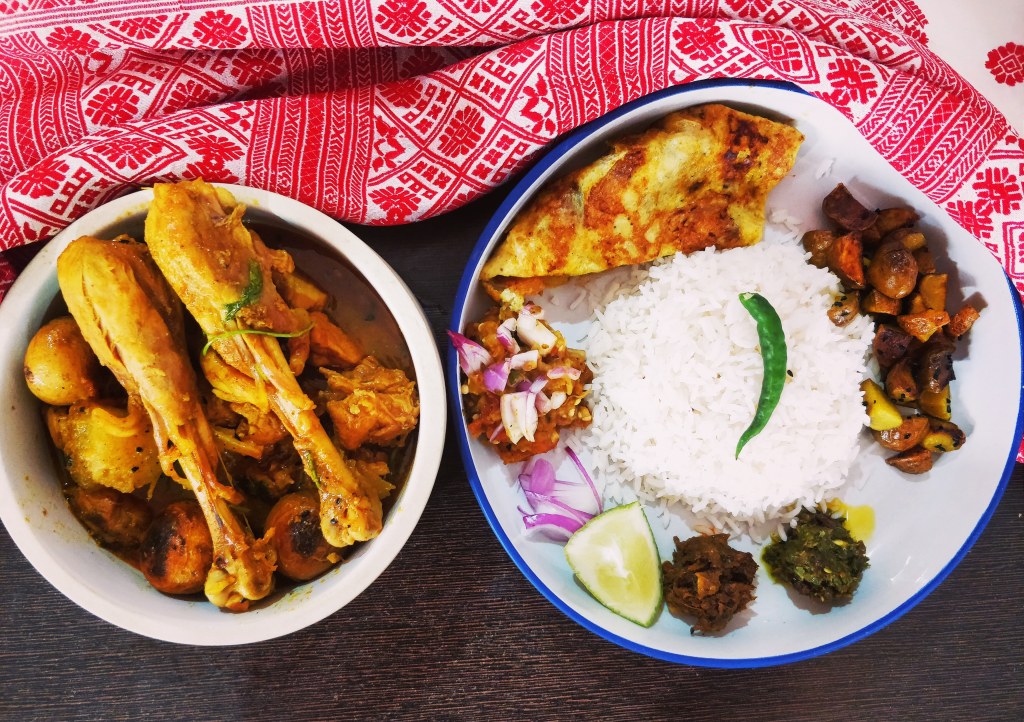
Today, as the music of “Bidexot Aapun Manuh” plays in my background and I write this, sitting in my house with no celebration around me, I do not indulge in a hefty expensive meal available only in one restaurant in Bangalore with Assamese food that is not satisfactory enough to give me festive feels or meet up strangers from my state when all my life I have embarrassingly introduced myself to strangers talking in Assamese saying, “Apuni Oxomiya ne? Moi’u Axom’or. Kor pora Apuni?” including an onsite Assamese manager in my office yesterday (laughs). Today, for the first time, I attempt an Assamese meal, feed to my close friends and as I see them devouring into the Patolia Omita di Murghir Jhul (Local Chicken Curry with Papaya) and Bengena-Bilahi pitika (Burnt Brinjal and Tomato Mash), licking their fingers and asking for more, a festive feel is achieved and I feel a little less lonely.

How are you celebrating Bihu/Lohri/Makar Sankranti/Pongal?

Happy Bhogali Bihu everyone!

On my plate:

  1. Patolia Bhootjolokia, Kaji Nemu & Omita di Murghir Jhul (Light Chicken Curry with Ghost Pepper, Kaffir Lime, Papaya and Baby Potatoes)
  2. Bhaat (Steamed Rice)
  3. Sukaan maasor chutney (Dry fish chutney)
  4. Dhoniya Paator chutney (Coriander chutney)
  5. Guti Aloo bhaaji (Baby potato fry)
  6. Koni (Omelette)
  7. Pura Nohoru-Begena-Bilahi pitika (Roasted garlic-brinjal-tomato mash)
Bhogali Bihu special lunch at home

If you liked this food story and want to see more of this mother-daughter duo, don’t forget to reach out to us at rannabaati00@gmail.com and our Instagram Handle @rannabaati by Oliva Das. We look forward to your requests and feedback!
Design a site like this with WordPress.com
Get started